BTRC Enlisted Walkie Talkie Vendor in Bangladesh
The History of Walkie-Talkies: From WWII to Modern Radios

Walkie-talkies are now a familiar communication tool used by security teams, factories, hotels, construction companies, event organizers, outdoor teams, and businesses around the world. With a simple push of a button, users can communicate instantly without relying on a mobile phone call.
But the modern handheld radio has a fascinating history. The technology was developed from early portable radio systems and became especially important during World War II, when soldiers needed reliable communication while moving across difficult terrain.
From heavy backpack-mounted radios to compact digital and 4G Push-to-Talk devices, the evolution of the walkie-talkie reflects more than 80 years of advances in radio engineering.
In this guide, we explore the history of walkie-talkies, who helped develop the technology, how military radios transformed into commercial two-way radios, and how modern walkie-talkies continue to evolve.
What Is a Walkie-Talkie?
A walkie-talkie is a portable two-way radio transceiver that allows people to communicate using radio waves.
Unlike a conventional telephone, a traditional walkie-talkie normally uses push-to-talk (PTT) communication. One person presses the transmit button and speaks, while the other users listen. When the button is released, the radio returns to receiving mode.
This simple communication method makes walkie-talkies particularly useful when a group needs fast, direct communication.
Modern radios can include features such as:
- Multiple channels
- UHF or VHF operation
- Digital communication
- Noise reduction
- Emergency functions
- Long-lasting batteries
- Water and dust resistance
- Group communication
- GPS and data functions on some professional systems
- 4G Push-to-Talk over Cellular (PoC)
Read More about: What Is Walkie Talkie?
Where Did the Walkie-Talkie Come From?
The history of the walkie-talkie began before the term itself became popular.
Portable radio communication was already being explored during the 1930s. One important figure was Canadian inventor Donald Hings, who developed a portable radio signaling system in 1937 for his employer, CM&S. Hings referred to the equipment as a “packset.” The technology was later adapted for military communication.
Hings’ work is an important part of the story because it demonstrated that radio communication could be made portable enough for people working away from fixed communication stations.
His C-58 radio eventually entered military service during World War II following further development.
However, another major milestone came from the United States, where military requirements accelerated the development of portable two-way radios.
Walkie-Talkies During World War II
World War II dramatically increased the need for reliable portable communication.
Military commanders needed soldiers, officers, artillery units, and other personnel to communicate quickly while moving through battlefields. Traditional wired communication systems were difficult to maintain when troops were constantly moving.
Portable radios offered a solution.
One of the most important developments came from Galvin Manufacturing Corporation, the company that later became Motorola. The company developed the SCR-300, a backpack-mounted FM portable radio for the U.S. Army Signal Corps. Motorola describes the SCR-300 as the world’s first FM portable two-way radio.
The SCR-300 was considerably larger and heavier than the handheld radios people associate with the term “walkie-talkie” today. It weighed around 35 pounds (15.9 kg), including its battery system, and operated in the 40–48 MHz range.
Despite its size, the radio represented a major technological breakthrough.
It allowed infantry units to maintain wireless communication while moving through the battlefield.
Why Was the SCR-300 So Important?
The SCR-300 introduced several important improvements over earlier portable radio designs.
It used frequency modulation (FM) rather than the older AM approach. Military testing showed that FM provided clearer voice communication and was less affected by certain types of electrical interference.
The radio also offered:
- Portable field operation
- Multiple selectable frequencies
- Better resistance to interference
- Improved voice quality
- Reliable military-grade construction
- Communication over several miles under suitable conditions
The SCR-300 was used extensively by Allied forces in Europe and the Pacific. Motorola states that production began in 1943 and that more than 45,000 units were produced before the end of the war.
Other historical sources place production close to 50,000 units.
The technology became particularly valuable during major campaigns including Normandy, Anzio, Guadalcanal, and Iwo Jima.
The “Walkie-Talkie” Name
Interestingly, the original SCR-300 was not a small handheld radio.
It was a backpack radio.
The name “walkie-talkie” became associated with the SCR-300 because soldiers could carry the radio while walking and communicate wirelessly. The U.S. Army’s technical documentation described the SCR-300 as being intended as a walkie-talkie for foot combat troops.
This is why the historical meaning of “walkie-talkie” can sometimes be confusing.
The early SCR-300 was backpack-mounted, while smaller handheld radios were also developed during the same period.
The Handie-Talkie: A Smaller Radio
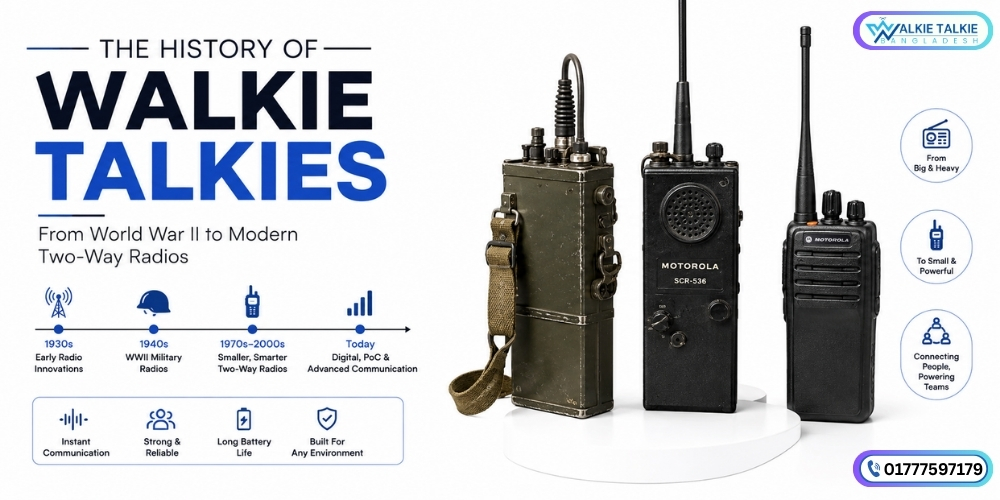
One of the most important steps toward the modern handheld walkie-talkie was the Motorola SCR-536, commonly known as the “Handie-Talkie.”
Unlike the larger SCR-300, the SCR-536 was designed to be held in one hand.
It was an AM radio and was significantly smaller than the backpack-mounted SCR-300. IEEE Spectrum notes that Motorola began shipping smaller handheld models during World War II, helping establish the distinction between “walkie-talkie” and “handie-talkie.”
The basic concept was revolutionary:
A soldier could carry the radio directly instead of carrying a large backpack unit.
This was a crucial step toward the compact handheld radios we use today.
From Vacuum Tubes to Transistors
Early walkie-talkies were very different from modern radios.
They used vacuum tubes, large batteries, and relatively bulky electronic components.
As electronics technology improved, manufacturers began replacing vacuum tubes with smaller and more efficient solid-state components.
This allowed radios to become:
- Smaller
- Lighter
- More reliable
- More energy efficient
- Easier to manufacture
- More affordable
The transition from vacuum-tube electronics to solid-state technology was one of the most important developments in the evolution of portable radios.
Eventually, radios became small enough to comfortably carry on a belt or inside a pocket.
Walkie-Talkies After World War II
After World War II, two-way radio technology moved beyond military applications.
Police departments, firefighters, transportation companies, industrial organizations, amateur radio operators, and other professional users began adopting portable and mobile radio systems.
Manufacturers continued improving radio technology by introducing better batteries, smaller components, improved antennas, higher frequencies, and more reliable receivers.
Walkie-talkies became increasingly useful for organizations that needed instant communication between team members.
The technology was no longer limited to soldiers.
It became a practical business communication solution.
The Rise of Commercial Two-Way Radios
During the following decades, manufacturers developed increasingly sophisticated commercial radios.
Businesses began using two-way radios for:
- Security operations
- Construction
- Manufacturing
- Transportation
- Warehousing
- Hotels
- Events
- Emergency services
- Utilities
- Outdoor operations
The fundamental principle remained simple:
Press the button → speak → release the button → listen.
That simplicity is one reason walkie-talkies have remained relevant even as smartphones became widespread.
The Development of UHF and VHF Radios
As radio technology matured, different frequency bands became important for different applications.
Two of the most commonly discussed bands are:
UHF — Ultra High Frequency
UHF radios are commonly used in built-up and indoor environments.
They are frequently considered for applications such as:
- Security
- Garment factories
- Warehouses
- Hotels
- Commercial buildings
- Events
However, frequency alone does not determine communication performance. Concrete walls, floors, metal structures, machinery, antenna design, radio configuration, and interference can all affect real-world coverage.
VHF — Very High Frequency
VHF radios can be useful in many outdoor and relatively open environments.
Typical applications can include:
- Construction
- Agriculture
- Outdoor events
- Field operations
- Large open properties
The correct choice depends on the actual environment rather than simply selecting a radio based on a manufacturer’s maximum range claim.
For businesses in Bangladesh, our Walkie-Talkie collection includes different radio technologies and models that can be compared according to application and specifications.
The Digital Walkie-Talkie Revolution
One of the biggest changes in recent decades has been the transition from analogue to digital two-way radio.
Traditional analogue radios transmit voice as an analogue radio signal. Digital radios convert voice information into digital data before transmission.
Depending on the system, digital radios can offer features such as:
- Improved communication management
- Group calling
- Private calling
- Better noise handling
- More efficient spectrum use
- Data capabilities
- Advanced system management
- Enhanced security features on supported systems
Digital radio systems can be particularly valuable for larger organizations that need structured communication across multiple teams.
The Emergence of 4G PoC Walkie-Talkies
Modern communication technology has taken walkie-talkies beyond traditional radio-frequency coverage.
4G PoC, or Push-to-Talk over Cellular, uses cellular networks to provide push-to-talk communication.
Instead of relying entirely on direct radio-to-radio coverage, PoC devices use mobile data networks.
This can make them useful for organizations with employees operating across:
- Multiple branches
- Different districts
- Large geographic areas
- Transport routes
- Logistics networks
- Field operations
However, because PoC systems depend on cellular connectivity, network availability is an important consideration.
This represents a major shift in the history of walkie-talkies: the basic push-to-talk experience remains, but the underlying communication network can now be fundamentally different.
How Modern Walkie-Talkies Compare With Early Models
The difference between a World War II radio and a modern professional handheld is remarkable.
| Feature | Early Walkie-Talkies | Modern Professional Radios |
|---|---|---|
| Size | Large and heavy | Compact and lightweight |
| Electronics | Vacuum tubes | Solid-state electronics |
| Battery | Large batteries | Rechargeable lithium-ion options |
| Communication | Mainly analogue | Analogue and digital |
| Channels | Limited | Multiple programmable channels |
| Audio | Basic | Advanced audio processing |
| Durability | Military field construction | Ruggedized professional designs |
| Features | Basic voice communication | Groups, scanning, alerts, data and more |
| Connectivity | Direct radio | Radio, repeater, digital or cellular/PoC |
| Applications | Primarily military | Business, industrial, public safety and consumer use |
The basic concept has remained remarkably consistent, but the technology behind it has changed dramatically.
Why Walkie-Talkies Are Still Relevant Today
With smartphones available almost everywhere, it may seem surprising that walkie-talkies are still widely used.
But professional radio has several advantages.
Instant Push-to-Talk Communication
A user can press one button and communicate with a group immediately.
Group Communication
A single transmission can reach multiple team members on the same channel or talk group.
Reduced Dependence on Individual Phone Numbers
Teams can communicate through organized channels rather than making individual calls.
Useful in Work Environments
Walkie-talkies are designed for situations where users may need to communicate while working, moving, driving, monitoring, or managing operations.
Professional Durability
Many professional radios are designed for demanding environments where ordinary consumer electronics may not be ideal.
Flexible Communication Systems
Modern organizations can choose from analogue, digital, repeater-based, SBR, or 4G PoC solutions depending on their requirements.
Walkie-Talkies in Bangladesh
Today, walkie-talkies are used by businesses and organizations in Bangladesh for a wide variety of purposes.
Common applications include:
- Security companies
- Garment factories
- Hotels
- Construction projects
- Warehouses
- Shopping centres
- Corporate offices
- Event management
- Transport and logistics
- Industrial facilities
The right radio depends on the working environment.
For example, a security team inside a multi-story building may have very different requirements from a construction team working across an open site.
That is why choosing a radio based only on advertised range or price can be misleading.
If you are comparing current models, technologies, and prices, visit the Walkie-Talkie category at Walkie Talkie Bangladesh to explore available options.
The Future of Walkie-Talkies
The history of walkie-talkies shows a continuous trend toward better portability, reliability, connectivity, and functionality.
Future two-way radio systems are likely to combine traditional radio communication with modern digital technologies.
We can already see this direction through:
- Digital radio
- 4G and cellular push-to-talk
- GPS-enabled communication
- Remote device management
- Data communication
- Advanced noise cancellation
- Cloud-based communication platforms
- Integrated emergency functions
- Hybrid radio and cellular systems
The physical walkie-talkie may continue to become smaller and more intelligent, while the communication network behind it becomes increasingly sophisticated.
Frequently Asked Questions About the History of Walkie-Talkies
Who invented the walkie-talkie?
There is not one simple inventor credited with every form of walkie-talkie technology. Canadian inventor Donald Hings developed an important portable radio signaling system in 1937, while several engineers and organizations contributed to the military development of portable two-way radios. The Motorola/Galvin SCR-300 became the first widely recognized radio to receive the “walkie-talkie” nickname.
When was the first walkie-talkie invented?
Important portable radio development began during the 1930s. Donald Hings developed his portable “packset” system in 1937, while the Motorola SCR-300 was developed around the beginning of the 1940s and entered wartime production in 1943.
Was the first walkie-talkie used during World War II?
Yes. Portable two-way radios became extremely important during World War II. The SCR-300 was widely used by Allied forces in both European and Pacific operations.
What was the first handheld walkie-talkie?
The Motorola SCR-536, commonly called the “Handie-Talkie,” was an early handheld military two-way radio developed during World War II. It was much smaller than the backpack-mounted SCR-300.
How have walkie-talkies changed over time?
Walkie-talkies evolved from large vacuum-tube, battery-powered military radios into compact solid-state devices. Modern models can support analogue and digital communication, multiple channels, advanced audio features, and even cellular 4G Push-to-Talk systems.
Are walkie-talkies still useful when smartphones exist?
Yes. Walkie-talkies remain useful for professional teams that need fast group communication, simple push-to-talk operation, and purpose-built communication equipment. They are widely used in security, factories, construction, hotels, events, warehouses, and other operational environments.
What is the difference between an old walkie-talkie and a modern radio?
Early radios were large, heavy, and based on vacuum-tube technology. Modern radios are much smaller and can use solid-state electronics, rechargeable batteries, digital communication, advanced audio processing, and cellular networks.
Learn More About Walkie-Talkies
The history of walkie-talkies explains how two-way radio technology evolved, but understanding how these devices work and how to choose the right one is equally important. If you want to learn more before choosing a walkie-talkie for personal, business, or professional use, explore these related guides from Walkie Talkie Bangladesh:
- [What Is a Walkie-Talkie?] — Learn how walkie-talkies work, how push-to-talk communication operates, and the basic technology behind modern two-way radios. What Is a Walkie-Talkie?
- [Real Walkie-Talkie Range in Bangladesh] — Discover how far a walkie-talkie can actually communicate in real-world conditions and which factors affect its practical range. Real Walkie-Talkie Range in Bangladesh
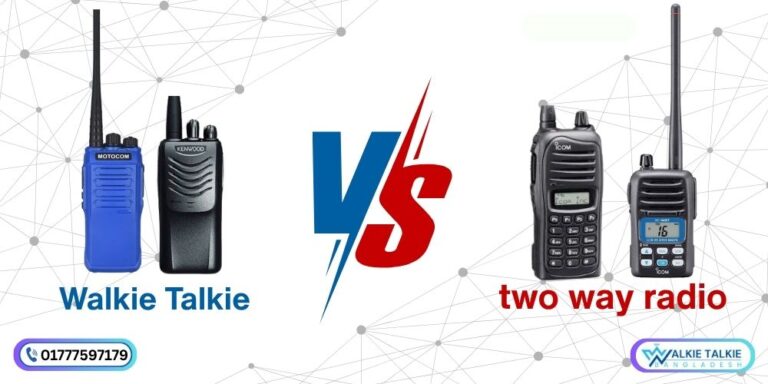
- [Walkie-Talkie vs Two-Way Radio] — Understand the difference between walkie-talkies and two-way radios and which terminology and technology are more suitable for different applications. Walkie-Talkie vs Two-Way Radio
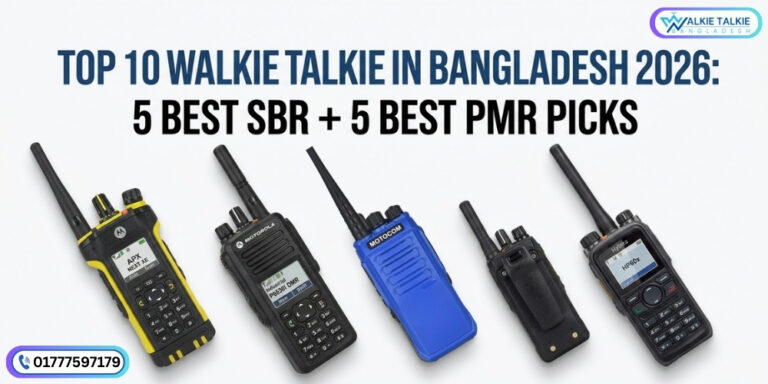
- [Top 10 Walkie-Talkies in Bangladesh] — Compare some of the most popular walkie-talkie options available in Bangladesh and learn what to consider when selecting a model. Top 10 Walkie-Talkies in Bangladesh
Whether you are interested in the history, technology, communication range, or practical use of walkie-talkies, these guides can help you build a better understanding before choosing the right communication solution.