BTRC Enlisted Walkie Talkie Vendor in Bangladesh
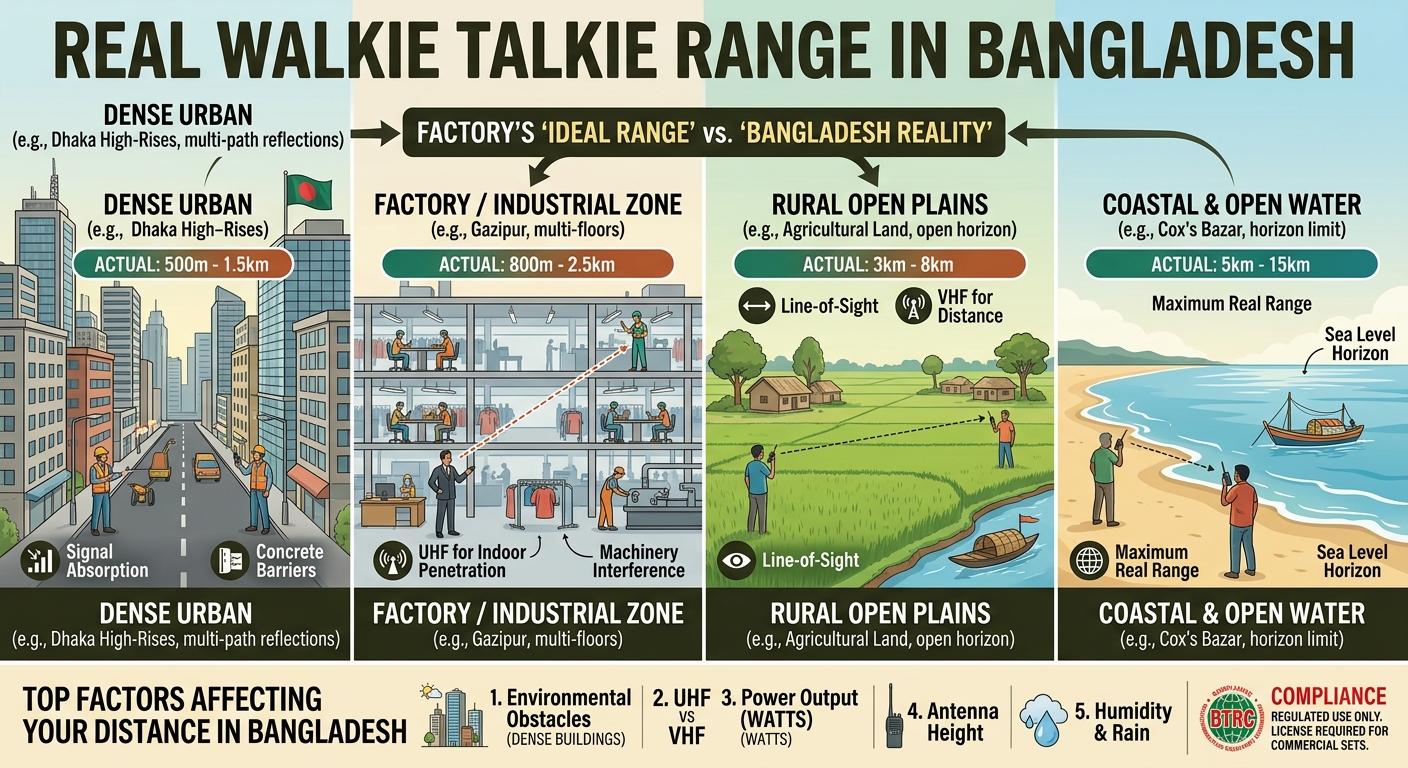
Real Walkie Talkie Range In Bangladesh: What Distance Can You Actually Expect?

What Is the Real Walkie Talkie Range in Bangladesh?
The real walkie talkie range in Bangladesh depends heavily on the environment.
A professional handheld radio may cover hundreds of meters inside a large concrete building, several kilometers in an urban area, and considerably farther in open terrain. A repeater-based professional radio system can extend coverage much further.
Here is a practical reference:
| Environment | Approximate Practical Range | Main Challenge |
|---|---|---|
| Small office | 200 m – 800 m | Interior walls |
| Large building | 300 m – 1.5 km | Concrete and multiple floors |
| Dense urban area | 500 m – 3 km | Buildings and interference |
| Industrial/factory area | 1 – 5 km | Metal structures and machinery |
| Construction site | 1 – 5+ km | Obstacles and changing structures |
| Open rural area | 3 – 10+ km | Terrain and antenna height |
| Elevated location | 5 – 15+ km | Equipment and line of sight |
| Repeater-based system | 10 – 50+ km | System design and infrastructure |
Important: These are practical planning estimates, not guaranteed distances. Actual performance varies according to radio model, frequency, transmitter power, antenna, terrain, building construction, interference, and installation quality.
Comprehensive Outline
| Section | Topic | Search Intent |
| 1 | Real Walkie Talkie Range in Bangladesh | Informational |
| 2 | Advertised Range vs Real Range | Informational |
| 3 | Range by Environment | Informational |
| 4 | Factors Affecting Range | Informational |
| 5 | Transmitter Power | Informational |
| 6 | Antenna and Antenna Height | Informational |
| 7 | Frequency and BTRC Regulations | Informational |
| 8 | SBR vs PMR | Commercial |
| 9 | Digital vs Analog | Commercial |
| 10 | Repeater Systems | Commercial |
| 11 | Range Testing | How-to |
| 12 | Improving Range | How-to |
| 13 | Choosing the Right Radio | Commercial |
| 14 | Common Mistakes | Informational |
| 15 | Bangladesh Business Applications | Commercial |
| 16 | FAQs | AEO |
| 17 | Conclusion | Commercial/Informational |
Understanding Real Walkie Talkie Range in Bangladesh
When people search for a long-range walkie-talkie, they usually want one simple answer: “How many kilometers will it cover?”
Unfortunately, radio communication doesn’t work that simply.
A walkie-talkie’s range isn’t a fixed number. The same radio can perform very differently in different locations.
For example, imagine two employees using the same professional radio model.
One employee is standing in an open field. The second employee is several kilometers away with a clear line of sight. The radios may communicate surprisingly well.
Now place both employees inside reinforced concrete buildings in a dense city. The effective range may drop dramatically.
That’s why real-world range is more important than advertised range.
Why Advertised Range Can Be Misleading
Manufacturers may advertise a maximum range based on ideal conditions.
Those conditions can include:
- Open terrain
- Clear line of sight
- Minimal interference
- Suitable antenna positioning
- Elevated locations
- Proper battery condition
- Favorable environmental conditions
Real Bangladesh environments are usually more complicated.
Dhaka, Chattogram, Gazipur, Narayanganj, Sylhet, Rajshahi, and other populated areas can contain dense buildings, concrete structures, factories, roads, electrical equipment, and other obstacles.
Therefore, a radio advertised as having a 20 km range shouldn’t automatically be expected to provide 20 km of reliable handheld-to-handheld communication.
Advertised Range vs Practical Range
| Advertised Range | Possible Urban Range | Possible Open-Area Range | Typical Situation |
| 3 km | 500 m – 1.5 km | 2 – 3+ km | Basic short-range radio |
| 5 km | 1 – 3 km | 3 – 5+ km | Business handheld |
| 10 km | 2 – 5 km | 5 – 10+ km | Professional outdoor use |
| 20 km | 3 – 8+ km | 10 – 20+ km | Favorable terrain |
| 30 km | Highly variable | 15 – 30+ km | Specialized conditions |
| 50 km | Highly variable | Potentially possible | Usually requires favorable conditions or infrastructure |
Note: The figures above are general planning estimates. They aren’t promises from a manufacturer and shouldn’t replace a real coverage test.
Real Walkie Talkie Range by Location in Bangladesh
The operating environment is one of the biggest factors affecting radio coverage.
A walkie-talkie used inside a shopping mall isn’t facing the same conditions as a radio used in an open agricultural field.
Walkie Talkie Range in Dhaka
Dhaka presents a challenging environment for radio communication.
Large buildings, reinforced concrete, narrow streets, elevators, metal structures, underground areas, and electrical equipment can all affect radio signals.
In many urban situations, a professional handheld radio may provide useful communication over approximately 500 meters to several kilometers, but the exact result can vary significantly.
For a hotel or office building, the important question isn’t:
“Can this radio reach 20 km?”
Instead, ask:
“Can this radio reliably cover every floor, room, entrance, parking area, and service zone where my employees work?”
That’s a much better purchasing question.
Walkie Talkie Range in Rural Areas
Rural environments can provide better radio performance because there are often fewer physical obstacles.
Open farmland, highways, riverbanks, large outdoor sites, and relatively flat areas can offer much better line-of-sight conditions.
A professional handheld may therefore communicate several kilometers in suitable rural conditions.
However, rural doesn’t mean unlimited range.
The following still matter:
- Antenna height
- Transmitter power
- Receiver sensitivity
- Frequency
- Terrain
- Vegetation
- Equipment quality
Range by Environment
| Environment | Expected Performance | Approximate Practical Range | Main Problem |
| Open field | Excellent | 3 – 10+ km | Distance |
| Rural farmland | Good to excellent | 3 – 10+ km | Vegetation |
| Highway | Good | 3 – 10+ km | Terrain and vehicles |
| Dense city | Moderate to poor | 500 m – 3 km | Buildings |
| Shopping mall | Moderate to poor | 200 m – 1 km | Concrete and metal |
| Hotel | Moderate | 300 m – 1.5 km | Floors and walls |
| Factory | Moderate | 1 – 5 km | Machinery and steel |
| Construction site | Moderate to good | 1 – 5+ km | Structures |
| Basement | Poor | 50 – 500 m | Underground concrete |
| Large campus | Variable | 2 – 10+ km | Multiple buildings |
The 8 Biggest Factors That Affect Walkie Talkie Range
There isn’t one specification that determines range.
Instead, several factors work together.
1. Transmitter Power
Transmitter power is normally measured in watts.
A professional handheld radio may have considerably more transmitting capability than a basic consumer radio.
However, 5 watts does not mean 5 kilometers.
Power is only one part of the equation.
Increasing power may improve the signal under certain conditions, but it won’t magically make a signal pass through every concrete wall or around every hill.
2. Antenna Quality
The antenna is extremely important.
A suitable, properly installed antenna can have a major effect on communication performance.
Poor antenna positioning can reduce effective performance even when the radio itself is excellent.
For handheld radios, keep the antenna as upright and unobstructed as practical.
3. Antenna Height
Height can make a significant difference.
A higher antenna can provide a clearer line of sight between radios.
This is one reason professional systems may use:
- Base stations
- Elevated antennas
- Rooftop antennas
- Repeaters
- Towers
4. Terrain
Physical terrain can block radio signals.
Large buildings, hills, embankments, dense vegetation, and other obstacles can reduce coverage.
Even when Bangladesh’s terrain is relatively flat in many areas, local obstacles can still make a significant difference.
5. Buildings
Buildings are among the biggest challenges in urban radio communication.
Reinforced concrete, steel, metal doors, elevators, underground rooms, and thick walls can weaken signals.
A radio that performs well outdoors may perform very differently inside a multi-floor building.
6. Interference
Other radio systems and electronic equipment can affect communication.
Professional radio systems should therefore be configured and installed carefully.
7. Receiver Sensitivity
Range isn’t just about transmitting.
The receiving radio must also be able to detect and process a weak signal.
A high-quality receiver can therefore make a significant difference in practical communication.
8. Battery Condition
Battery performance matters, particularly for professional users.
A radio with a weak battery may become unreliable when it’s needed most.
For long shifts, consider spare batteries and proper charging procedures.
Does 5W Mean a 5 KM Walkie Talkie Range?
No.
This is one of the most common misunderstandings.
Watts measure transmitter power. Kilometers measure distance.
They aren’t interchangeable.
A 5W radio could provide excellent communication over several kilometers in open terrain and perform poorly inside a large concrete building.
Example
| Situation | 5W Radio Performance |
| Open field | Potentially several kilometers |
| Rural road | Potentially several kilometers |
| Dense city | Often significantly shorter |
| Large factory | Highly variable |
| Basement | Potentially very short |
| Repeater system | Much wider coverage possible |
So, when comparing radios, don’t focus on wattage alone.
Frequency and Walkie Talkie Range
Frequency affects radio propagation and system performance.
However, users shouldn’t simply choose a frequency because they believe it provides maximum range.
Radio frequencies and radio apparatus are regulated in Bangladesh.
The Bangladesh Telecommunication Regulatory Commission (BTRC) is the relevant authority for telecommunications and spectrum regulation. Its materials describe licensing and frequency-allocation requirements for radio apparatus, subject to applicable categories and exemptions.
For current regulatory information, consult the official BTRC website before purchasing or operating professional radio equipment.
This is particularly important if you’re importing radios from overseas.
A foreign seller saying that a radio is “license free” doesn’t automatically mean that the same equipment or frequency is unrestricted for use in Bangladesh.
SBR vs PMR Walkie Talkie Systems
Businesses often encounter terms such as SBR and PMR when shopping for professional radios.
Understanding the difference can help you choose more intelligently.
SBR — Shared Business Radio
SBR systems are designed for business communication and can be suitable for organizations that need reliable staff communication.
Typical users can include:
- Security teams
- Hotels
- Warehouses
- Factories
- Event teams
- Construction companies
- Logistics operations
PMR — Private Mobile Radio
PMR generally refers to professional radio communication systems designed around specific operational requirements.
A professional PMR deployment can involve:
- Handheld radios
- Base stations
- Repeaters
- Antennas
- Accessories
- Frequency planning
- Coverage testing
The best system depends on the organization and its coverage requirements.
SBR vs PMR Comparison
| Feature | SBR | PMR |
| Primary Purpose | Business communication | Professional communication |
| Typical Users | Small and medium businesses | Professional organizations |
| Handheld Radios | Yes | Yes |
| Repeater Support | Depending on system | Common in professional systems |
| Coverage | Depends on environment | Can be designed for specific coverage |
| Frequency Planning | Important | Very important |
| Professional Features | Varies | Often extensive |
| Best For | Business teams | Larger/specialized operations |
| Regulatory Compliance | Required | Required |
| Main Benefit | Practical business communication | Customizable professional system |
Digital vs Analog Walkie Talkies
Digital and analog radios can both be effective.
The right choice depends on your operational requirements.
Analog Radios
Analog radios are simple and widely used.
As the signal becomes weaker, audio usually becomes increasingly noisy.
Digital Radios
Digital systems can provide advanced functionality and, depending on the system, clearer voice communication.
Features may include:
- User identification
- Digital calling
- Messaging
- Group communication
- Advanced management features
- Better spectrum efficiency
However, digital technology does not automatically mean longer physical range.
Digital vs Analog Comparison
| Feature | Analog | Digital |
| Voice Communication | Good | Often clearer |
| Range | Environment dependent | Environment dependent |
| Digital Calling | Limited | Available on many systems |
| User ID | Limited | Often available |
| Messaging | Usually limited | Often available |
| Advanced Features | Fewer | More |
| Professional Use | Yes | Yes |
| Automatically Longer Range | No | No |
| Best For | Simple communication | Feature-rich professional systems |
How a Repeater Can Dramatically Increase Coverage
If you need to cover a large area, a repeater may be a better solution than simply buying higher-powered handheld radios.
A repeater receives a transmission and retransmits it.
The basic communication path looks like this:
Radio A → Repeater → Radio B
If the repeater is installed at a suitable elevated location, it can significantly extend the usable communication area.
Repeaters can be useful for:
- Large factories
- Hotels
- Resorts
- Security operations
- Construction projects
- Warehouses
- Campuses
- Large outdoor events
Direct Radio vs Repeater-Based Communication
| System Type | Coverage Potential | Installation | Best Application |
| Handheld → Handheld | Short to medium | Simple | Small teams |
| Handheld → Base Station | Medium to long | Moderate | Fixed operations |
| Handheld → Repeater → Handheld | Long | Professional | Large sites |
| Multiple Repeaters | Very long | Complex | Large-area operations |
A repeater isn’t automatically required for every business.
The right approach is to perform a coverage test first.
What Is a Realistic Walkie Talkie Range for Different Businesses?
Different businesses have different communication requirements.
A small retail store doesn’t need the same radio system as a large industrial facility.
Business Application Guide
| Business | Typical Coverage Requirement | Recommended Approach |
| Retail Store | Short | Professional handheld |
| Restaurant | Short to medium | Compact professional radio |
| Hotel | Medium to large | Professional radio + coverage test |
| Security Company | Medium to large | Professional radio system |
| Factory | Large | Rugged radio + possible repeater |
| Construction | Medium to large | Rugged handheld |
| Warehouse | Medium | Professional handheld |
| Event Management | Medium to large | Professional handheld + spare batteries |
| Resort | Large | Professional radio + repeater |
| Logistics | Variable | Professional radio system |
| Large Campus | Large | Repeater/base station |
How to Test Walkie Talkie Range Before Buying
If communication is important for your business, don’t rely only on product specifications.
Perform a real-world test.
Step 1: Fully Charge the Radios
Start with fully charged batteries.
Step 2: Place One Radio at the Main Operating Point
Keep Radio A at a fixed location.
Step 3: Move the Second Radio Away
Walk or drive away gradually with Radio B.
Step 4: Record Communication Quality
Don’t only record whether you can hear the other person.
Record the quality.
Communication Quality Test
| Signal Quality | What You Hear | Reliability |
| Excellent | Clear voice | Excellent |
| Good | Clear with minor noise | Reliable |
| Fair | Some noise | Usable |
| Weak | Frequent interruptions | Risky |
| Very Weak | Difficult to understand | Poor |
| No Signal | No communication | Unusable |
Continue the test until communication becomes unreliable.
Then test the difficult areas.
For a building, test:
- Basement
- Stairwell
- Elevator area
- Parking area
- Upper floors
- Storage rooms
- Loading areas
- Outdoor perimeter
This will give you a much more realistic idea of coverage.
Practical Walkie Talkie Range Testing Table
| Test Stage | Action | Result to Record |
| 1 | Charge both radios | Battery condition |
| 2 | Select fixed location | Location |
| 3 | Start at close distance | Initial clarity |
| 4 | Increase distance gradually | Distance |
| 5 | Check voice quality | Audio quality |
| 6 | Continue until weak | Weak-signal distance |
| 7 | Continue until failure | Maximum usable distance |
| 8 | Test indoors | Indoor coverage |
| 9 | Test outdoors | Outdoor coverage |
| 10 | Test difficult areas | Dead zones |
| 11 | Repeat if equipment changes | Comparison |
| 12 | Document results | Final decision |
How to Improve Walkie Talkie Range
If your current radios aren’t providing sufficient coverage, there are several practical solutions.
Improve Antenna Position
Keep the antenna upright and away from unnecessary obstructions.
Increase Antenna Height
For professional systems, increasing antenna height can substantially improve coverage.
Use Suitable Professional Equipment
A professional radio may offer better receiver performance, audio quality, durability, and battery life than a low-cost consumer model.
Improve System Design
Proper frequency planning, antenna selection, and installation can make a major difference.
Use a Repeater
For large areas, a repeater can provide a much bigger improvement than simply increasing handheld transmitter power.
Ways to Improve Coverage
| Improvement | Potential Impact | Recommended For |
| Better antenna positioning | High | All users |
| Higher antenna location | Very high | Large outdoor areas |
| Professional handheld radio | High | Businesses |
| Better receiver sensitivity | High | Weak-signal environments |
| Proper frequency planning | High | Professional systems |
| Repeater | Very high | Large sites |
| Base station | High | Fixed locations |
| Coverage survey | Very high | Critical operations |
| Spare batteries | Reliability improvement | Long shifts |
| Rugged equipment | Operational improvement | Industrial environments |
Does Weather Affect Walkie Talkie Range in Bangladesh?
Weather usually isn’t the biggest factor affecting handheld radio range.
In most practical situations, physical obstacles are more important.
The biggest factors are usually:
- Buildings
- Terrain
- Antenna height
- Antenna quality
- Frequency
- Transmitter power
- Receiver sensitivity
- Interference
However, Bangladesh’s humid and rainy climate makes equipment durability important.
For outdoor users, consider radios designed for the working environment.
A construction worker may need a rugged, weather-resistant radio, while an office employee may not need the same level of protection.
Why Do Walkie Talkies Have Dead Zones?
A dead zone is an area where communication becomes weak or completely unavailable.
Dead zones can occur because of:
- Reinforced concrete
- Metal structures
- Underground locations
- Elevators
- Large machinery
- Hills
- Poor antenna placement
- Interference
- Insufficient signal strength
A dead zone doesn’t necessarily mean the radio is defective.
It may indicate that the overall radio system needs better coverage planning.
Choosing the Best Walkie Talkie for Bangladesh
Don’t start by asking:
“Which radio has the longest range?”
Start by asking:
“Where will I use the radio?”
Then consider the following.
For Offices
Prioritize:
- Compact design
- Clear audio
- Battery life
- Reliable indoor coverage
For Hotels
Prioritize:
- Indoor coverage
- Multi-floor performance
- Clear audio
- Earpiece compatibility
- Possible repeater support
For Factories
Prioritize:
- Rugged construction
- Strong audio
- Building penetration
- Battery life
- Repeater compatibility
For Construction
Prioritize:
- Ruggedness
- Dust and water resistance
- Battery capacity
- Strong audio
- Practical coverage
For Security Teams
Prioritize:
- Reliability
- Battery life
- Clear communication
- Durable design
- Suitable accessories
- Professional support
Walkie Talkie Selection Guide
| Requirement | Important Features | Recommended Solution |
| Small office | Compact and reliable | Professional handheld |
| Retail shop | Simple communication | Compact professional radio |
| Hotel | Indoor coverage | Professional radio |
| Factory | Ruggedness and coverage | Professional radio + possible repeater |
| Construction | Durability | Rugged professional handheld |
| Security | Reliability and audio | Professional radio system |
| Resort | Wide-area coverage | Professional radio + repeater |
| Event | Battery and coverage | Professional handheld + spare batteries |
| Rural operation | Long open-area coverage | Professional radio + suitable antenna |
| Large campus | Wide coverage | Repeater/base-station system |
Where to Buy Walkie Talkies in Bangladesh
If you’re researching professional radio equipment, accessories, repeaters, and related services, you can explore Walkie Talkie Bangladesh.
The website focuses on walkie-talkie communication solutions in Bangladesh and can be used to explore relevant categories and products.
When selecting a product, however, don’t make the decision based only on the advertised range.
Instead, compare:
- Required coverage area
- Indoor or outdoor usage
- Number of users
- Battery requirements
- Antenna requirements
- Repeater requirements
- Durability
- Audio quality
- Frequency requirements
- Applicable BTRC requirements
Common Walkie Talkie Range Mistakes
Mistake 1: Buying Based Only on Kilometers
A radio advertised at 30 km isn’t necessarily the best radio for a five-floor building.
Mistake 2: Assuming More Watts Always Means More Range
Power helps, but it isn’t the whole system.
Mistake 3: Ignoring the Antenna
A poor or unsuitable antenna can negatively affect performance.
Mistake 4: Ignoring Buildings
Concrete and metal can dramatically reduce indoor coverage.
Mistake 5: Ignoring Regulations
Users should verify applicable BTRC requirements before operating professional radio equipment.
Mistake 6: Not Testing the Actual Location
A real coverage test is often more useful than a specification sheet.
Walkie Talkie Range: Quick Comparison
| Range Category | Approximate Distance | Typical Application |
| Very Short | 50 – 500 m | Small indoor areas |
| Short | 500 m – 2 km | Offices and shops |
| Medium | 2 – 5 km | Business and urban outskirts |
| Long | 5 – 10 km | Rural/open areas |
| Extended | 10 – 20+ km | Specialized systems |
| Wide Area | 20 – 50+ km | Repeater/infrastructure systems |
Remember: These ranges are general planning categories. Actual results can vary considerably.
Frequently Asked Questions
1. What is the real walkie talkie range in Bangladesh?
The real range can vary from a few hundred meters to many kilometers. In dense urban areas, practical coverage may be around 500 meters to 3 kilometers, while open terrain can provide several kilometers or more.
2. Can a walkie-talkie really reach 20 km?
Yes, 20 km communication can be possible under favorable conditions, especially with suitable equipment, antenna positioning, elevation, or infrastructure. However, you shouldn’t assume that a standard handheld radio will always provide 20 km of reliable coverage.
3. Does a 5W walkie-talkie reach 5 km?
No. Five watts refers to transmitter power, not distance.
A 5W radio may cover several kilometers in favorable conditions but much less inside buildings or dense urban areas.
4. What is the best walkie-talkie range for Dhaka?
For Dhaka, reliable urban coverage is more important than maximum advertised distance.
A professional handheld may provide useful coverage from hundreds of meters to several kilometers depending on the specific location.
5. Is walkie-talkie range better in rural Bangladesh?
Generally, yes.
Open terrain typically provides better line-of-sight conditions than dense urban areas.
6. Does a repeater increase walkie-talkie range?
Yes.
A properly designed repeater system can significantly extend communication coverage by receiving and retransmitting radio signals.
7. Does antenna height improve range?
Yes.
A higher antenna can improve line of sight and therefore increase practical coverage.
8. Do concrete buildings reduce radio range?
Yes.
Concrete, steel, elevators, underground structures, and metal objects can significantly weaken radio signals.
9. Is digital walkie-talkie better than analog?
Digital radios can offer clearer audio and more advanced features, but digital technology doesn’t automatically provide longer physical range.
10. Are walkie-talkies legal in Bangladesh?
Radio equipment and frequency usage are subject to applicable Bangladesh telecommunications regulations. Users should verify current BTRC requirements for the specific equipment and frequency before operation.
11. How can I increase my walkie-talkie range?
You can improve coverage through suitable antennas, better antenna positioning, increased antenna height, professional radio equipment, proper system planning, and repeater infrastructure where required.
12. What is more important: range or reliability?
For business communication, reliability is usually more important.
A radio that consistently works throughout your required operating area is more useful than a radio that reaches a very distant point only under ideal conditions.
Final Verdict: What Real Range Should You Expect?
The real walkie talkie range in Bangladesh isn’t a single number.
As a practical guideline:
| Environment | Reasonable Planning Expectation |
| Small indoor area | 200 m – 800 m |
| Large building | 300 m – 1.5 km |
| Dense urban area | 500 m – 3 km |
| Industrial site | 1 – 5 km |
| Construction site | 1 – 5+ km |
| Rural/open area | 3 – 10+ km |
| Elevated professional setup | 5 – 15+ km |
| Repeater-based system | 10 – 50+ km or more |
The biggest lesson is simple:
Don’t buy a walkie-talkie because it has the biggest number on the box. Buy the radio system that can reliably cover the area where your team actually works.
For a small office, a professional handheld may be enough.
For a factory, hotel, resort, or large construction project, you may need a more carefully designed radio system.
And for very large coverage requirements, a repeater or elevated antenna system may provide a much better solution than simply purchasing higher-powered handheld radios.
Before operating professional radio equipment in Bangladesh, also verify the applicable regulatory and frequency requirements through the official Bangladesh Telecommunication Regulatory Commission (BTRC).
For walkie-talkie products, accessories, repeaters, and professional communication solutions, visit Walkie Talkie Bangladesh.
What Is the Real Walkie Talkie Range in Bangladesh?
The real walkie talkie range in Bangladesh depends heavily on the environment.
A professional handheld radio may cover hundreds of meters inside a large concrete building, several kilometers in an urban area, and considerably farther in open terrain. A repeater-based professional radio system can extend coverage much further.
Here is a practical reference:
| Environment | Approximate Practical Range | Main Challenge |
|---|---|---|
| Small office | 200 m – 800 m | Interior walls |
| Large building | 300 m – 1.5 km | Concrete and multiple floors |
| Dense urban area | 500 m – 3 km | Buildings and interference |
| Industrial/factory area | 1 – 5 km | Metal structures and machinery |
| Construction site | 1 – 5+ km | Obstacles and changing structures |
| Open rural area | 3 – 10+ km | Terrain and antenna height |
| Elevated location | 5 – 15+ km | Equipment and line of sight |
| Repeater-based system | 10 – 50+ km | System design and infrastructure |
Important: These are practical planning estimates, not guaranteed distances. Actual performance varies according to radio model, frequency, transmitter power, antenna, terrain, building construction, interference, and installation quality.
Comprehensive Outline
| Section | Topic | Search Intent |
| 1 | Real Walkie Talkie Range in Bangladesh | Informational |
| 2 | Advertised Range vs Real Range | Informational |
| 3 | Range by Environment | Informational |
| 4 | Factors Affecting Range | Informational |
| 5 | Transmitter Power | Informational |
| 6 | Antenna and Antenna Height | Informational |
| 7 | Frequency and BTRC Regulations | Informational |
| 8 | SBR vs PMR | Commercial |
| 9 | Digital vs Analog | Commercial |
| 10 | Repeater Systems | Commercial |
| 11 | Range Testing | How-to |
| 12 | Improving Range | How-to |
| 13 | Choosing the Right Radio | Commercial |
| 14 | Common Mistakes | Informational |
| 15 | Bangladesh Business Applications | Commercial |
| 16 | FAQs | AEO |
| 17 | Conclusion | Commercial/Informational |
Understanding Real Walkie Talkie Range in Bangladesh
When people search for a long-range walkie-talkie, they usually want one simple answer: “How many kilometers will it cover?”
Unfortunately, radio communication doesn’t work that simply.
A walkie-talkie’s range isn’t a fixed number. The same radio can perform very differently in different locations.
For example, imagine two employees using the same professional radio model.
One employee is standing in an open field. The second employee is several kilometers away with a clear line of sight. The radios may communicate surprisingly well.
Now place both employees inside reinforced concrete buildings in a dense city. The effective range may drop dramatically.
That’s why real-world range is more important than advertised range.
Why Advertised Range Can Be Misleading
Manufacturers may advertise a maximum range based on ideal conditions.
Those conditions can include:
- Open terrain
- Clear line of sight
- Minimal interference
- Suitable antenna positioning
- Elevated locations
- Proper battery condition
- Favorable environmental conditions
Real Bangladesh environments are usually more complicated.
Dhaka, Chattogram, Gazipur, Narayanganj, Sylhet, Rajshahi, and other populated areas can contain dense buildings, concrete structures, factories, roads, electrical equipment, and other obstacles.
Therefore, a radio advertised as having a 20 km range shouldn’t automatically be expected to provide 20 km of reliable handheld-to-handheld communication.
Advertised Range vs Practical Range
| Advertised Range | Possible Urban Range | Possible Open-Area Range | Typical Situation |
| 3 km | 500 m – 1.5 km | 2 – 3+ km | Basic short-range radio |
| 5 km | 1 – 3 km | 3 – 5+ km | Business handheld |
| 10 km | 2 – 5 km | 5 – 10+ km | Professional outdoor use |
| 20 km | 3 – 8+ km | 10 – 20+ km | Favorable terrain |
| 30 km | Highly variable | 15 – 30+ km | Specialized conditions |
| 50 km | Highly variable | Potentially possible | Usually requires favorable conditions or infrastructure |
Note: The figures above are general planning estimates. They aren’t promises from a manufacturer and shouldn’t replace a real coverage test.
Real Walkie Talkie Range by Location in Bangladesh
The operating environment is one of the biggest factors affecting radio coverage.
A walkie-talkie used inside a shopping mall isn’t facing the same conditions as a radio used in an open agricultural field.
Walkie Talkie Range in Dhaka
Dhaka presents a challenging environment for radio communication.
Large buildings, reinforced concrete, narrow streets, elevators, metal structures, underground areas, and electrical equipment can all affect radio signals.
In many urban situations, a professional handheld radio may provide useful communication over approximately 500 meters to several kilometers, but the exact result can vary significantly.
For a hotel or office building, the important question isn’t:
“Can this radio reach 20 km?”
Instead, ask:
“Can this radio reliably cover every floor, room, entrance, parking area, and service zone where my employees work?”
That’s a much better purchasing question.
Walkie Talkie Range in Rural Areas
Rural environments can provide better radio performance because there are often fewer physical obstacles.
Open farmland, highways, riverbanks, large outdoor sites, and relatively flat areas can offer much better line-of-sight conditions.
A professional handheld may therefore communicate several kilometers in suitable rural conditions.
However, rural doesn’t mean unlimited range.
The following still matter:
- Antenna height
- Transmitter power
- Receiver sensitivity
- Frequency
- Terrain
- Vegetation
- Equipment quality
Range by Environment
| Environment | Expected Performance | Approximate Practical Range | Main Problem |
| Open field | Excellent | 3 – 10+ km | Distance |
| Rural farmland | Good to excellent | 3 – 10+ km | Vegetation |
| Highway | Good | 3 – 10+ km | Terrain and vehicles |
| Dense city | Moderate to poor | 500 m – 3 km | Buildings |
| Shopping mall | Moderate to poor | 200 m – 1 km | Concrete and metal |
| Hotel | Moderate | 300 m – 1.5 km | Floors and walls |
| Factory | Moderate | 1 – 5 km | Machinery and steel |
| Construction site | Moderate to good | 1 – 5+ km | Structures |
| Basement | Poor | 50 – 500 m | Underground concrete |
| Large campus | Variable | 2 – 10+ km | Multiple buildings |
The 8 Biggest Factors That Affect Walkie Talkie Range
There isn’t one specification that determines range.
Instead, several factors work together.
1. Transmitter Power
Transmitter power is normally measured in watts.
A professional handheld radio may have considerably more transmitting capability than a basic consumer radio.
However, 5 watts does not mean 5 kilometers.
Power is only one part of the equation.
Increasing power may improve the signal under certain conditions, but it won’t magically make a signal pass through every concrete wall or around every hill.
2. Antenna Quality
The antenna is extremely important.
A suitable, properly installed antenna can have a major effect on communication performance.
Poor antenna positioning can reduce effective performance even when the radio itself is excellent.
For handheld radios, keep the antenna as upright and unobstructed as practical.
3. Antenna Height
Height can make a significant difference.
A higher antenna can provide a clearer line of sight between radios.
This is one reason professional systems may use:
- Base stations
- Elevated antennas
- Rooftop antennas
- Repeaters
- Towers
4. Terrain
Physical terrain can block radio signals.
Large buildings, hills, embankments, dense vegetation, and other obstacles can reduce coverage.
Even when Bangladesh’s terrain is relatively flat in many areas, local obstacles can still make a significant difference.
5. Buildings
Buildings are among the biggest challenges in urban radio communication.
Reinforced concrete, steel, metal doors, elevators, underground rooms, and thick walls can weaken signals.
A radio that performs well outdoors may perform very differently inside a multi-floor building.
6. Interference
Other radio systems and electronic equipment can affect communication.
Professional radio systems should therefore be configured and installed carefully.
7. Receiver Sensitivity
Range isn’t just about transmitting.
The receiving radio must also be able to detect and process a weak signal.
A high-quality receiver can therefore make a significant difference in practical communication.
8. Battery Condition
Battery performance matters, particularly for professional users.
A radio with a weak battery may become unreliable when it’s needed most.
For long shifts, consider spare batteries and proper charging procedures.
Does 5W Mean a 5 KM Walkie Talkie Range?
No.
This is one of the most common misunderstandings.
Watts measure transmitter power. Kilometers measure distance.
They aren’t interchangeable.
A 5W radio could provide excellent communication over several kilometers in open terrain and perform poorly inside a large concrete building.
Example
| Situation | 5W Radio Performance |
| Open field | Potentially several kilometers |
| Rural road | Potentially several kilometers |
| Dense city | Often significantly shorter |
| Large factory | Highly variable |
| Basement | Potentially very short |
| Repeater system | Much wider coverage possible |
So, when comparing radios, don’t focus on wattage alone.
Frequency and Walkie Talkie Range
Frequency affects radio propagation and system performance.
However, users shouldn’t simply choose a frequency because they believe it provides maximum range.
Radio frequencies and radio apparatus are regulated in Bangladesh.
The Bangladesh Telecommunication Regulatory Commission (BTRC) is the relevant authority for telecommunications and spectrum regulation. Its materials describe licensing and frequency-allocation requirements for radio apparatus, subject to applicable categories and exemptions.
For current regulatory information, consult the official BTRC website before purchasing or operating professional radio equipment.
This is particularly important if you’re importing radios from overseas.
A foreign seller saying that a radio is “license free” doesn’t automatically mean that the same equipment or frequency is unrestricted for use in Bangladesh.
SBR vs PMR Walkie Talkie Systems
Businesses often encounter terms such as SBR and PMR when shopping for professional radios.
Understanding the difference can help you choose more intelligently.
SBR — Shared Business Radio
SBR systems are designed for business communication and can be suitable for organizations that need reliable staff communication.
Typical users can include:
- Security teams
- Hotels
- Warehouses
- Factories
- Event teams
- Construction companies
- Logistics operations
PMR — Private Mobile Radio
PMR generally refers to professional radio communication systems designed around specific operational requirements.
A professional PMR deployment can involve:
- Handheld radios
- Base stations
- Repeaters
- Antennas
- Accessories
- Frequency planning
- Coverage testing
The best system depends on the organization and its coverage requirements.
SBR vs PMR Comparison
| Feature | SBR | PMR |
| Primary Purpose | Business communication | Professional communication |
| Typical Users | Small and medium businesses | Professional organizations |
| Handheld Radios | Yes | Yes |
| Repeater Support | Depending on system | Common in professional systems |
| Coverage | Depends on environment | Can be designed for specific coverage |
| Frequency Planning | Important | Very important |
| Professional Features | Varies | Often extensive |
| Best For | Business teams | Larger/specialized operations |
| Regulatory Compliance | Required | Required |
| Main Benefit | Practical business communication | Customizable professional system |
Digital vs Analog Walkie Talkies
Digital and analog radios can both be effective.
The right choice depends on your operational requirements.
Analog Radios
Analog radios are simple and widely used.
As the signal becomes weaker, audio usually becomes increasingly noisy.
Digital Radios
Digital systems can provide advanced functionality and, depending on the system, clearer voice communication.
Features may include:
- User identification
- Digital calling
- Messaging
- Group communication
- Advanced management features
- Better spectrum efficiency
However, digital technology does not automatically mean longer physical range.
Digital vs Analog Comparison
| Feature | Analog | Digital |
| Voice Communication | Good | Often clearer |
| Range | Environment dependent | Environment dependent |
| Digital Calling | Limited | Available on many systems |
| User ID | Limited | Often available |
| Messaging | Usually limited | Often available |
| Advanced Features | Fewer | More |
| Professional Use | Yes | Yes |
| Automatically Longer Range | No | No |
| Best For | Simple communication | Feature-rich professional systems |
How a Repeater Can Dramatically Increase Coverage
If you need to cover a large area, a repeater may be a better solution than simply buying higher-powered handheld radios.
A repeater receives a transmission and retransmits it.
The basic communication path looks like this:
Radio A → Repeater → Radio B
If the repeater is installed at a suitable elevated location, it can significantly extend the usable communication area.
Repeaters can be useful for:
- Large factories
- Hotels
- Resorts
- Security operations
- Construction projects
- Warehouses
- Campuses
- Large outdoor events
Direct Radio vs Repeater-Based Communication
| System Type | Coverage Potential | Installation | Best Application |
| Handheld → Handheld | Short to medium | Simple | Small teams |
| Handheld → Base Station | Medium to long | Moderate | Fixed operations |
| Handheld → Repeater → Handheld | Long | Professional | Large sites |
| Multiple Repeaters | Very long | Complex | Large-area operations |
A repeater isn’t automatically required for every business.
The right approach is to perform a coverage test first.
What Is a Realistic Walkie Talkie Range for Different Businesses?
Different businesses have different communication requirements.
A small retail store doesn’t need the same radio system as a large industrial facility.
Business Application Guide
| Business | Typical Coverage Requirement | Recommended Approach |
| Retail Store | Short | Professional handheld |
| Restaurant | Short to medium | Compact professional radio |
| Hotel | Medium to large | Professional radio + coverage test |
| Security Company | Medium to large | Professional radio system |
| Factory | Large | Rugged radio + possible repeater |
| Construction | Medium to large | Rugged handheld |
| Warehouse | Medium | Professional handheld |
| Event Management | Medium to large | Professional handheld + spare batteries |
| Resort | Large | Professional radio + repeater |
| Logistics | Variable | Professional radio system |
| Large Campus | Large | Repeater/base station |
How to Test Walkie Talkie Range Before Buying
If communication is important for your business, don’t rely only on product specifications.
Perform a real-world test.
Step 1: Fully Charge the Radios
Start with fully charged batteries.
Step 2: Place One Radio at the Main Operating Point
Keep Radio A at a fixed location.
Step 3: Move the Second Radio Away
Walk or drive away gradually with Radio B.
Step 4: Record Communication Quality
Don’t only record whether you can hear the other person.
Record the quality.
Communication Quality Test
| Signal Quality | What You Hear | Reliability |
| Excellent | Clear voice | Excellent |
| Good | Clear with minor noise | Reliable |
| Fair | Some noise | Usable |
| Weak | Frequent interruptions | Risky |
| Very Weak | Difficult to understand | Poor |
| No Signal | No communication | Unusable |
Continue the test until communication becomes unreliable.
Then test the difficult areas.
For a building, test:
- Basement
- Stairwell
- Elevator area
- Parking area
- Upper floors
- Storage rooms
- Loading areas
- Outdoor perimeter
This will give you a much more realistic idea of coverage.
Practical Walkie Talkie Range Testing Table
| Test Stage | Action | Result to Record |
| 1 | Charge both radios | Battery condition |
| 2 | Select fixed location | Location |
| 3 | Start at close distance | Initial clarity |
| 4 | Increase distance gradually | Distance |
| 5 | Check voice quality | Audio quality |
| 6 | Continue until weak | Weak-signal distance |
| 7 | Continue until failure | Maximum usable distance |
| 8 | Test indoors | Indoor coverage |
| 9 | Test outdoors | Outdoor coverage |
| 10 | Test difficult areas | Dead zones |
| 11 | Repeat if equipment changes | Comparison |
| 12 | Document results | Final decision |
How to Improve Walkie Talkie Range
If your current radios aren’t providing sufficient coverage, there are several practical solutions.
Improve Antenna Position
Keep the antenna upright and away from unnecessary obstructions.
Increase Antenna Height
For professional systems, increasing antenna height can substantially improve coverage.
Use Suitable Professional Equipment
A professional radio may offer better receiver performance, audio quality, durability, and battery life than a low-cost consumer model.
Improve System Design
Proper frequency planning, antenna selection, and installation can make a major difference.
Use a Repeater
For large areas, a repeater can provide a much bigger improvement than simply increasing handheld transmitter power.
Ways to Improve Coverage
| Improvement | Potential Impact | Recommended For |
| Better antenna positioning | High | All users |
| Higher antenna location | Very high | Large outdoor areas |
| Professional handheld radio | High | Businesses |
| Better receiver sensitivity | High | Weak-signal environments |
| Proper frequency planning | High | Professional systems |
| Repeater | Very high | Large sites |
| Base station | High | Fixed locations |
| Coverage survey | Very high | Critical operations |
| Spare batteries | Reliability improvement | Long shifts |
| Rugged equipment | Operational improvement | Industrial environments |
Does Weather Affect Walkie Talkie Range in Bangladesh?
Weather usually isn’t the biggest factor affecting handheld radio range.
In most practical situations, physical obstacles are more important.
The biggest factors are usually:
- Buildings
- Terrain
- Antenna height
- Antenna quality
- Frequency
- Transmitter power
- Receiver sensitivity
- Interference
However, Bangladesh’s humid and rainy climate makes equipment durability important.
For outdoor users, consider radios designed for the working environment.
A construction worker may need a rugged, weather-resistant radio, while an office employee may not need the same level of protection.
Why Do Walkie Talkies Have Dead Zones?
A dead zone is an area where communication becomes weak or completely unavailable.
Dead zones can occur because of:
- Reinforced concrete
- Metal structures
- Underground locations
- Elevators
- Large machinery
- Hills
- Poor antenna placement
- Interference
- Insufficient signal strength
A dead zone doesn’t necessarily mean the radio is defective.
It may indicate that the overall radio system needs better coverage planning.
Choosing the Best Walkie Talkie for Bangladesh
Don’t start by asking:
“Which radio has the longest range?”
Start by asking:
“Where will I use the radio?”
Then consider the following.
For Offices
Prioritize:
- Compact design
- Clear audio
- Battery life
- Reliable indoor coverage
For Hotels
Prioritize:
- Indoor coverage
- Multi-floor performance
- Clear audio
- Earpiece compatibility
- Possible repeater support
For Factories
Prioritize:
- Rugged construction
- Strong audio
- Building penetration
- Battery life
- Repeater compatibility
For Construction
Prioritize:
- Ruggedness
- Dust and water resistance
- Battery capacity
- Strong audio
- Practical coverage
For Security Teams
Prioritize:
- Reliability
- Battery life
- Clear communication
- Durable design
- Suitable accessories
- Professional support
Walkie Talkie Selection Guide
| Requirement | Important Features | Recommended Solution |
| Small office | Compact and reliable | Professional handheld |
| Retail shop | Simple communication | Compact professional radio |
| Hotel | Indoor coverage | Professional radio |
| Factory | Ruggedness and coverage | Professional radio + possible repeater |
| Construction | Durability | Rugged professional handheld |
| Security | Reliability and audio | Professional radio system |
| Resort | Wide-area coverage | Professional radio + repeater |
| Event | Battery and coverage | Professional handheld + spare batteries |
| Rural operation | Long open-area coverage | Professional radio + suitable antenna |
| Large campus | Wide coverage | Repeater/base-station system |
Where to Buy Walkie Talkies in Bangladesh
If you’re researching professional radio equipment, accessories, repeaters, and related services, you can explore Walkie Talkie Bangladesh.
The website focuses on walkie-talkie communication solutions in Bangladesh and can be used to explore relevant categories and products.
When selecting a product, however, don’t make the decision based only on the advertised range.
Instead, compare:
- Required coverage area
- Indoor or outdoor usage
- Number of users
- Battery requirements
- Antenna requirements
- Repeater requirements
- Durability
- Audio quality
- Frequency requirements
- Applicable BTRC requirements
Common Walkie Talkie Range Mistakes
Mistake 1: Buying Based Only on Kilometers
A radio advertised at 30 km isn’t necessarily the best radio for a five-floor building.
Mistake 2: Assuming More Watts Always Means More Range
Power helps, but it isn’t the whole system.
Mistake 3: Ignoring the Antenna
A poor or unsuitable antenna can negatively affect performance.
Mistake 4: Ignoring Buildings
Concrete and metal can dramatically reduce indoor coverage.
Mistake 5: Ignoring Regulations
Users should verify applicable BTRC requirements before operating professional radio equipment.
Mistake 6: Not Testing the Actual Location
A real coverage test is often more useful than a specification sheet.
Walkie Talkie Range: Quick Comparison
| Range Category | Approximate Distance | Typical Application |
| Very Short | 50 – 500 m | Small indoor areas |
| Short | 500 m – 2 km | Offices and shops |
| Medium | 2 – 5 km | Business and urban outskirts |
| Long | 5 – 10 km | Rural/open areas |
| Extended | 10 – 20+ km | Specialized systems |
| Wide Area | 20 – 50+ km | Repeater/infrastructure systems |
Remember: These ranges are general planning categories. Actual results can vary considerably.
Frequently Asked Questions About Walkie Talkie Range in Bangladesh
1. What is the real walkie talkie range in Bangladesh?
The real range can vary from a few hundred meters to many kilometers. In dense urban areas, practical coverage may be around 500 meters to 3 kilometers, while open terrain can provide several kilometers or more.
2. Can a walkie-talkie really reach 20 km?
Yes, 20 km communication can be possible under favorable conditions, especially with suitable equipment, antenna positioning, elevation, or infrastructure. However, you shouldn’t assume that a standard handheld radio will always provide 20 km of reliable coverage.
3. Does a 5W walkie-talkie reach 5 km?
No. Five watts refers to transmitter power, not distance.
A 5W radio may cover several kilometers in favorable conditions but much less inside buildings or dense urban areas.
4. What is the best walkie-talkie range for Dhaka?
For Dhaka, reliable urban coverage is more important than maximum advertised distance.
A professional handheld may provide useful coverage from hundreds of meters to several kilometers depending on the specific location.
5. Is walkie-talkie range better in rural Bangladesh?
Generally, yes.
Open terrain typically provides better line-of-sight conditions than dense urban areas.
6. Does a repeater increase walkie-talkie range?
Yes.
A properly designed repeater system can significantly extend communication coverage by receiving and retransmitting radio signals.
7. Does antenna height improve range?
Yes.
A higher antenna can improve line of sight and therefore increase practical coverage.
8. Do concrete buildings reduce radio range?
Yes.
Concrete, steel, elevators, underground structures, and metal objects can significantly weaken radio signals.
9. Is digital walkie-talkie better than analog?
Digital radios can offer clearer audio and more advanced features, but digital technology doesn’t automatically provide longer physical range.
10. Are walkie-talkies legal in Bangladesh?
Radio equipment and frequency usage are subject to applicable Bangladesh telecommunications regulations. Users should verify current BTRC requirements for the specific equipment and frequency before operation.
11. How can I increase my walkie-talkie range?
You can improve coverage through suitable antennas, better antenna positioning, increased antenna height, professional radio equipment, proper system planning, and repeater infrastructure where required.
12. What is more important: range or reliability?
For business communication, reliability is usually more important.
A radio that consistently works throughout your required operating area is more useful than a radio that reaches a very distant point only under ideal conditions.
Final Verdict: What Real Range Should You Expect?
The real walkie talkie range in Bangladesh isn’t a single number.
As a practical guideline:
| Environment | Reasonable Planning Expectation |
| Small indoor area | 200 m – 800 m |
| Large building | 300 m – 1.5 km |
| Dense urban area | 500 m – 3 km |
| Industrial site | 1 – 5 km |
| Construction site | 1 – 5+ km |
| Rural/open area | 3 – 10+ km |
| Elevated professional setup | 5 – 15+ km |
| Repeater-based system | 10 – 50+ km or more |
The biggest lesson is simple:
Don’t buy a walkie-talkie because it has the biggest number on the box. Buy the radio system that can reliably cover the area where your team actually works.
For a small office, a professional handheld may be enough.
For a factory, hotel, resort, or large construction project, you may need a more carefully designed radio system.
And for very large coverage requirements, a repeater or elevated antenna system may provide a much better solution than simply purchasing higher-powered handheld radios.
Before operating professional radio equipment in Bangladesh, also verify the applicable regulatory and frequency requirements through the official Bangladesh Telecommunication Regulatory Commission (BTRC).
For walkie-talkie products, accessories, repeaters, and professional communication solutions, visit Walkie Talkie Bangladesh.