BTRC Enlisted Walkie Talkie Vendor in Bangladesh
Walkie Talkie vs Two Way Radio

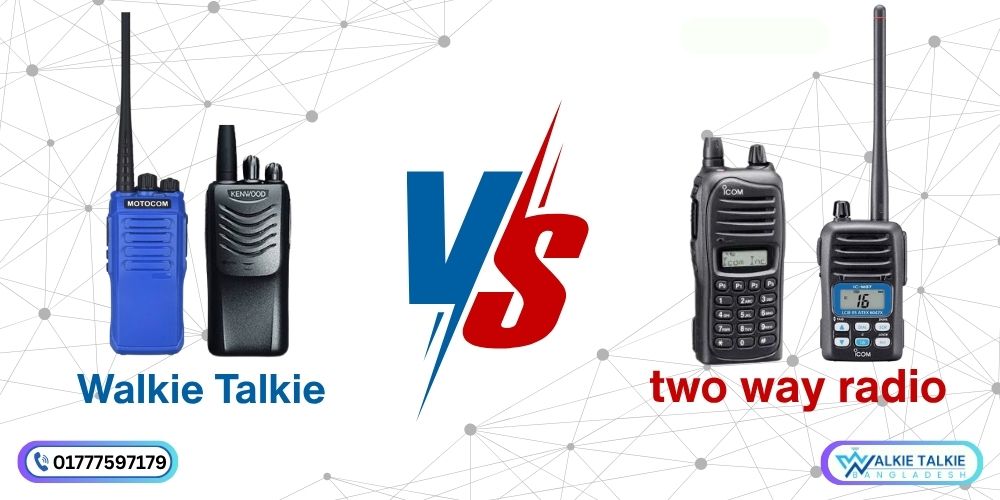
Walkie Talkie vs Two Way Radio: The Real Difference, Uses & Which One Is Right for You
Plenty of people walk into a shop — or type into Google — saying, “I need a walkie-talkie.” Others say, “I need a two-way radio.” And that’s when the obvious question shows up: walkie-talkie vs two-way radio — are these actually two different things, or the same thing with two names?
The short answer: a walkie-talkie is a type of two-way radio. But when it comes to real-world use, coverage, design, features, and professional setup, some differences genuinely matter. Especially in Bangladesh, where choosing the wrong device for a garments floor, a security team, a hotel, an event, a construction site, or a warehouse can quietly waste your money.
Featured Snippet Answer: What’s the Difference Between Walkie Talkie and Two Way Radio?
A walkie talkie is a handheld, push-to-talk two-way radio. A two-way radio is the broader category — it can mean a handheld walkie talkie, but also a mobile radio, a base station, or a repeater-supported radio system. So every walkie talkie is a two-way radio, but not every two-way radio is a walkie talkie.
Understand It in One Line
| Topic | Simple Explanation |
|---|---|
| Walkie Talkie | A handheld portable radio device, usually used for team communication |
| Two Way Radio | Any radio system that can both send and receive messages |
| Relationship | A walkie talkie is the portable version of a two-way radio |
| Key Difference | Walkie talkies are handheld; two-way radios can be handheld, vehicle-mounted, base stations, or repeater systems |
What Is a Walkie Talkie?
A walkie-talkie is a portable communication device that lets people on the same channel or frequency talk to each other. It almost always has a Push-to-Talk (PTT) button: you press it, you speak; you release it, the other person speaks.
The simple part? It doesn’t depend on a mobile network or a SIM card the way your phone does. Most traditional walkie-talkies communicate directly over radio frequency — which is exactly why they keep working when mobile networks get congested or go down.
If you want to start from the absolute basics, this guide will help: What Is a Walkie Talkie.
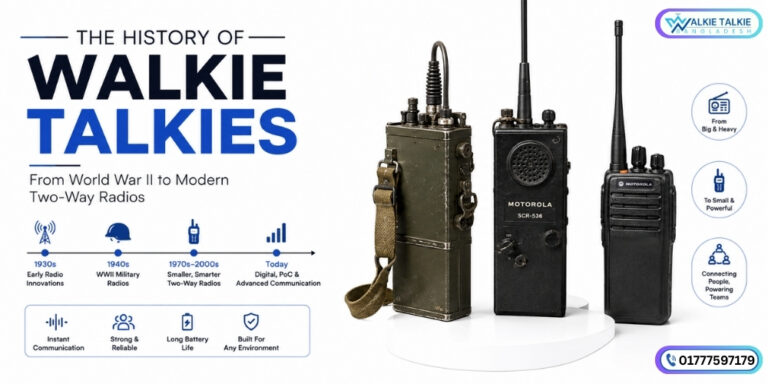
And if you’re curious about how the walkie-talkie went from military and emergency communication to today’s everyday business tool, read The History of Walkie Talkies.
What Is a Two Way Radio?
A two-way radio is any radio communication system that can both send and receive voice messages. That’s the “two-way” part — communication flows in both directions, not just one.
A two-way radio can be:
- A handheld radio
- A walkie-talkie
- A mobile radio, like the ones mounted in vehicles
- A base station radio
- A repeater-supported radio system
- An analogue or digital radio system
That’s why “two-way radio” is the broader, more professional term. Big companies, security teams, garment factories, industrial sites, and emergency services tend to use this word more often.
Walkie Talkie vs Two Way Radio: The Main Differences
| Comparison Point | Walkie Talkie | Two Way Radio |
|---|---|---|
| Category | A handheld type of two-way radio | The bigger communication category |
| Design | Usually a handheld portable device | Can be handheld, mobile, base station, or repeater system |
| Typical Use | Small teams, security, events, warehouses, restaurants | Professional teams, large sites, industry, transport, emergency, multi-building communication |
| Range | Short to medium, depends heavily on site conditions | Much wider coverage possible with repeaters or base stations |
| Power & Antenna | Usually compact power and antenna | Power, antenna, and repeater setup vary by system |
| Channel Management | Basic to moderate channel support | Advanced channels, group call, priority call, digital features |
| Professional Use | Security guards, hotels, restaurants, small factories | Garments, construction, logistics, large security operations, industrial zones |
| Price | Generally low to medium | Low, medium, or high depending on system type |
| Expansion | Great for limited teams | Far more flexible for big teams and future growth |
So Are They the Same Thing?
Yes and no — both answers are fair.
Yes, because a walkie-talkie is itself a two-way radio. Both devices send and receive voice.
No, because the words “two-way radio” don’t only mean a handheld walkie-talkie. They can also mean a much bigger radio communication system — vehicle radios, base stations, or a repeater network.
The easy formula:
- Walkie Talkie = portable handheld two-way radio
- Two Way Radio = the entire radio communication category
When Is a Walkie Talkie Enough?
If your work happens inside one building, on one floor, or among a nearby team running a smaller operation, a good-quality walkie talkie is often completely enough.
A walkie talkie is a solid choice for:
- Security guard communication
- Hotel or resort staff coordination
- Restaurants and event management
- Small warehouses
- School, hospital, or office maintenance teams
- Small construction site crews
- Parking management
- Retail store or shopping mall staff
Want to see what’s actually available right now? Browse the full range here: Walkie Talkie Product Category.
When Is a Professional Two Way Radio System Better?
If your communication area is large, spreads across multiple floors or buildings, involves a big team, or simply cannot afford dead zones — then instead of looking only at basic walkie talkies, it’s smarter to think about a professional two-way radio solution.
A two-way radio system works better for:
- Large garments factories
- Industrial areas
- Multi-building security operations
- Big warehouses and logistics hubs
- Construction projects
- Transport fleets
- Emergency response teams
- Large events and stadium management
In Bangladesh especially — across the big industrial and garments setups of Gazipur, Savar, Narayanganj, Chattogram, and Dhaka — a proper radio system is often what closes the communication gap that causes real operational losses.
Need a dedicated guide for factories? Read: Best Walkie Talkie for Garments.
Range and Coverage: Where Most Misunderstandings Happen
Whenever walkie talkie vs two way radio comes up, range creates the most confusion. Product descriptions love to claim 5 km, 10 km, or more. In reality, range depends on a long list of things:
- How thick the building walls are
- Whether there are basements or lift areas
- How many metal racks or machines are in the way
- Indoor vs outdoor use
- Antenna quality
- Frequency type — VHF or UHF
- Battery condition
- Whether a repeater is being used
- Interference in the surrounding area
As a rule of thumb, a standalone handheld walkie talkie is great for one premises or a nearby team. But to cover a genuinely large area, a repeater-supported two-way radio system is usually far more effective.
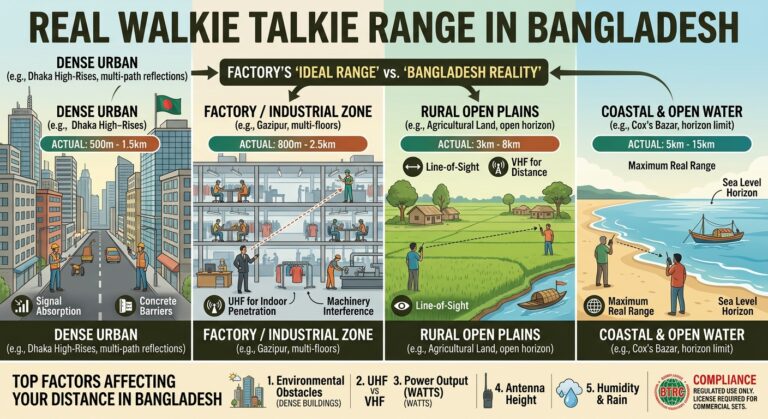
For an honest look at what range actually looks like in Bangladeshi conditions, read: Real Walkie Talkie Range in Bangladesh.
Which Is Better for Security Guards?
Security guards usually need a device that’s durable, loud and clear, strong on battery, and dead simple to use — because their job is about fast response. The system doesn’t need to be complicated, but the communication has to be reliable.
When choosing a device for security guards, check:
- How good the battery backup is
- Whether it supports a belt clip and earpiece
- Whether the audio is loud and clear
- Whether it’s easy to use on night duty
- Whether the signal stays stable inside the building
- Whether there are enough channels for multiple guard posts
See our dedicated recommendations here: Best Walkie Talkie for Security Guard.
Which Is Better for a Garments Factory?
Communication in a garments factory is its own beast. Production floor, cutting section, finishing, store, security gate, admin, maintenance — all of them need fast contact. On top of that, there’s usually heavy noise, large floors, and walls or machines that block signal.
So in a garments factory, buying “the cheapest walkie talkie” rarely ends well. Instead, think about:
- How many floors need coverage
- How many users there will be
- Whether noise cancellation or clear audio is needed
- Battery backup for long shifts
- Whether spare batteries will be needed
- Whether staff will use earpieces
- Whether more devices will be added later
A practical buying guide for factories is here: Best Walkie Talkie for Garments.
Walkie Talkie vs Two Way Radio: Which Should You Buy?
The simplest decision rule is this — understand the scale of your work first.
Buy a walkie talkie if:
- You need small-team communication
- You’re covering one building or a nearby area
- The use case is security, hotel, restaurant, event, or small warehouse
- Simple push-to-talk is enough
- You want to keep the budget controlled
- The users aren’t technical and need an easy device
Consider a professional two-way radio system if:
- You need to cover a large area
- There are multiple buildings or multiple floors
- The team is big
- Communication is mission-critical
- You may need a repeater or base station
- You’re building a long-term business communication setup
- You need channel management, privacy, or advanced features
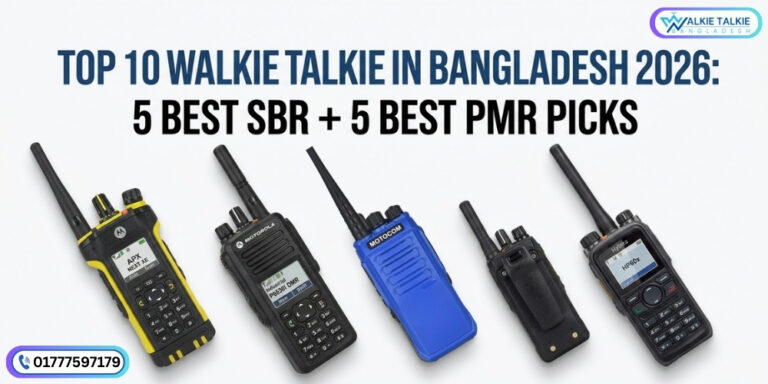
Still confused between specific models? This list will shortlist things fast: Top 10 Walkie Talkie in Bangladesh.
Analog or Digital: Which Is Better?
Another question that shows up at buying time: analog or digital?
Analog radios are usually simpler, more cost-effective, and perfectly fine for basic communication. For security guards, small businesses, or simple coordination, analog is often enough.
Digital radios generally offer clearer audio, better privacy, noise reduction, text/data features, group management, and sometimes better battery efficiency. But digital systems usually need a bit more planning and budget.
If your work is simple, analog is a good starting point. For big factories, professional security, or industrial communication, digital is worth serious consideration.
Checklist Before Buying a Walkie Talkie / Two Way Radio in Bangladesh
Before you buy anything, write down answers to these questions:
- How many users will use it?
- Will communication be mostly indoor or outdoor?
- How many floors or buildings need coverage?
- What’s the use case — security, garments, hotel, warehouse?
- How many hours of battery backup do you need?
- Will you need earpieces, mics, chargers, spare batteries?
- Will there be heavy noise?
- Will you add more devices in the future?
- Can you do a real range test before committing?
- Is the device and frequency use compliant with local regulations?
Radio frequency use in Bangladesh is a sensitive matter. For commercial or professional use, it’s always smarter to go with approved devices, proper frequencies, and support from an authorized seller.
Common Misconceptions: Let’s Clear These Up
1. “Walkie talkie means a toy device.”
No. Toy walkie talkies exist — and so do professional-grade ones. Security, garments, hotel, and industrial use demand professional devices.
2. “Two way radio means something totally different from a walkie talkie.”
Not always. A walkie talkie is a two-way radio. The term “two way radio” is just broader.
3. “More watts means more range.”
Watts alone don’t decide range. Antenna, frequency, building structure, height, and interference all matter.
4. “You need a SIM to run a walkie talkie.”
Traditional walkie talkies and two-way radios work on radio frequency — no SIM required.
5. “All brands will work together.”
Not always. They need matching frequency, channel spacing, privacy codes, and compatibility.
Quick Decision Table
| Your Need | Recommended Option |
|---|---|
| Small office or shop team | Basic walkie talkie |
| Security guard team | Durable professional walkie talkie |
| Hotel / restaurant / event | Compact walkie talkie with earpiece |
| Garments factory | Professional walkie talkie or two-way radio setup |
| Multi-building area | Repeater-supported two-way radio system |
| Long-term industrial use | Scalable two-way radio solution |
| Budget-friendly shortlist | Top 10 Walkie Talkie in Bangladesh |
FAQs: Walkie Talkie vs Two Way Radio
Is a walkie talkie a two way radio?
Yes. A walkie talkie is a handheld portable two-way radio. But “two-way radio” can also mean mobile radios, base stations, or repeater systems.
What’s the main difference between a walkie talkie and a two way radio?
The main difference is scope. A walkie talkie is usually a handheld portable device, while two-way radio is the bigger category that includes many types of radio communication systems.
Which has more range — walkie talkie or two way radio?
Range isn’t decided by the category name. That said, a repeater-supported professional two-way radio system can usually cover a much larger area than a standalone walkie talkie.
Which is better for security guards — walkie talkie or two way radio?
For small to medium security teams, a professional walkie talkie is enough. For large sites, multiple gates, or multi-building security, a two-way radio system may be better.
Which is better for a garments factory?
Usually a professional walkie talkie or a planned two-way radio setup — because garments floors have noise, multiple levels, machine interference, and big-team communication.
Does a walkie talkie need internet?
No. Traditional walkie talkies and two-way radios work over radio frequency, without internet or a mobile network.
Can different brands of walkie talkie work together?
Often yes — if they share the same frequency, channel, codes, and technical compatibility. Still, confirm with the seller or a technician before buying.
Is using a walkie talkie legal in Bangladesh?
For professional or commercial use, approved devices and proper frequency compliance are essential. Buy from a reliable supplier and follow local regulations.
Last Words
If your gut still says “I just need a walkie talkie,” pause for two minutes. Write down your site size, number of floors, number of users, and your real range requirement. Do that before picking a model — it’s the single best way to avoid buying the wrong device.
Ready to look at actual devices? Start here: Walkie Talkie Product Category.
Want to understand range before spending a single taka? Read this first: Real Walkie Talkie Range in Bangladesh.
If your use case is a security team, go straight to: Best Walkie Talkie for Security Guard.
And if you’re buying for a garments factory, this guide will save you the most time: Best Walkie Talkie for Garments.
Pick the right device, and you’re not just buying a radio — you’re buying faster response time, tighter coordination, and a daily operation that finally runs smooth.