BTRC Enlisted Walkie Talkie Vendor in Bangladesh
What Is Walkie-Talkie? Definition, How It Works, Types, Range & Uses

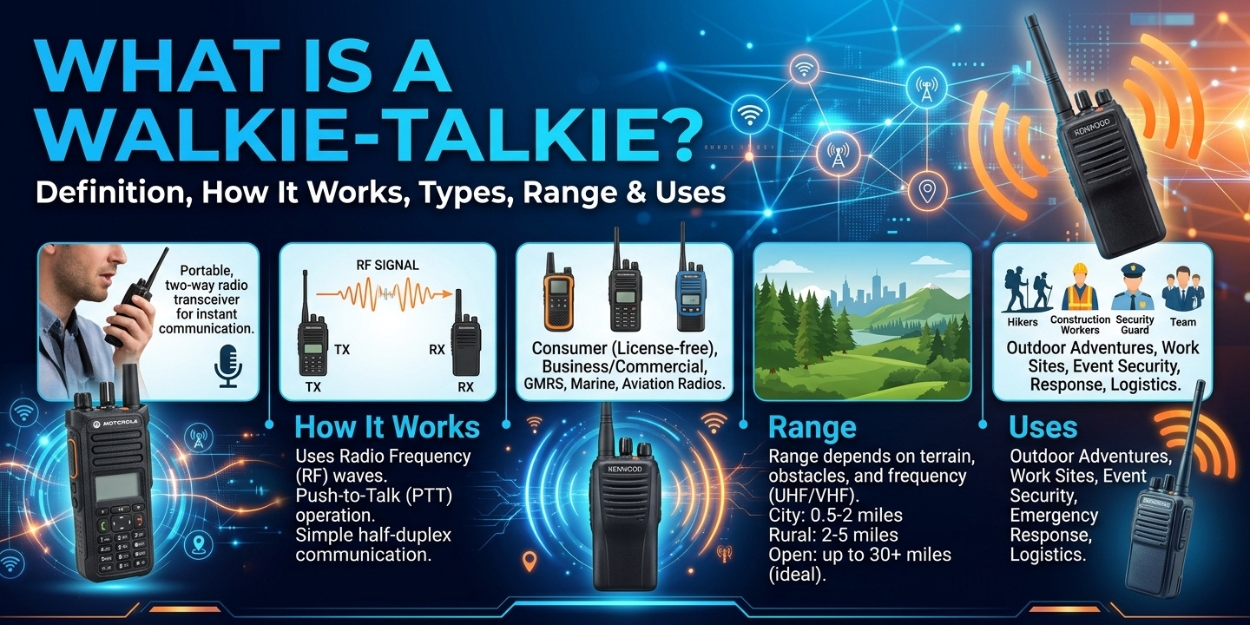
A walkie-talkie is a portable two-way radio that lets people communicate instantly over radio frequencies without relying on mobile networks or the internet. Security teams, businesses, factories, hotels, event organizers, and industrial organizations commonly use them for fast, reliable communication.
Unlike mobile phones, walkie-talkies allow multiple users to communicate through the same channel using a push-to-talk (PTT) button, making them an efficient solution for team communication.
What Is a Walkie Talkie?
A walkie-talkie is a handheld wireless communication device that works as both a transmitter and receiver. It allows users to send and receive voice messages through radio waves.
Simply put, a walkie-talkie works like a portable radio telephone: one person speaks while others on the same frequency listen. consists of:
- Microphone for capturing voice
- Transmitter for sending signals
- Receiver for receiving communication
- Speaker for audio output
- Antenna for radio transmission
- Battery for power supply
The modern walkie-talkie, also known as a handheld two-way radio, is widely used for professional communication.
How Does a Walkie Talkie Work?
A walkie-talkie works by converting voice into radio signals and transmitting them through a specific frequency.
The communication process happens in three steps:
1. Voice Conversion
When a user presses the Push-To-Talk (PTT) button and speaks, the microphone converts the voice into an electronic signal.
2. Radio Transmission
The transmitter sends the signal through a selected radio frequency.
3. Signal Reception
Another walkie-talkie operating on the same frequency receives the signal and converts it back into sound.
This allows users to communicate instantly without needing an internet connection.
- Phone call charges.
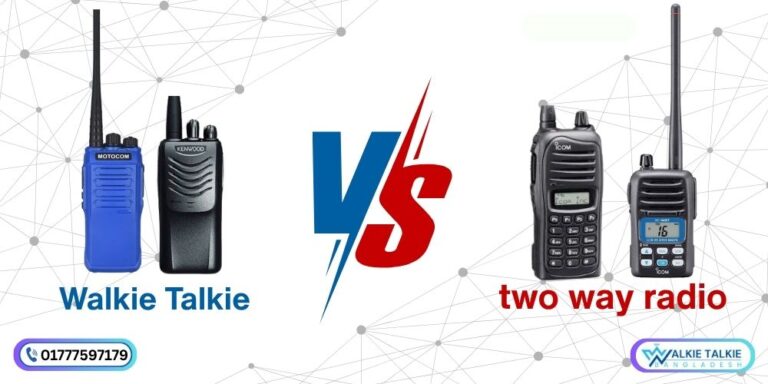
Walkie Talkie vs Two Way Radio: What Is The Difference?
Many people use “walkie-talkie” and “two-way radio” interchangeably, but there is a difference.
A walkie-talkie is actually a type of two-way radio.
A two-way radio is a broader category that includes:
- Handheld radios
- Mobile radios
- Base station radios
- Repeater communication systems
A walkie-talkie specifically refers to portable handheld radios that users can carry while moving.
To understand the detailed difference between these communication systems, read:
Types of Walkie Talkies
Different industries require various types of walkie-talkies depending on communication distance, environment, and features.
Analog Walkie Talkie
Analog radios use traditional radio transmission technology.
Advantages:
- Simple operation
- Affordable cost
- Easy maintenance
- Wide compatibility
They suit basic communication needs.
Digital Walkie Talkie
Digital radios use advanced signal processing technology.
Benefits:
- Better audio quality
- Improved communication efficiency
- Advanced security features
- Better performance in professional environments
They are commonly used by businesses and organizations requiring reliable communication.
VHF Walkie Talkie
VHF (Very High Frequency) radios are generally better for open outdoor environments.
Common uses:
- Construction sites
- Agriculture
- Large open areas
UHF Walkie Talkie
UHF (Ultra High Frequency) radios perform better in areas with buildings and obstacles.
Common uses:
- Factories
- Hotels
- Shopping malls
- Security operations
What Are Walkie Talkies Used For?
Walkie-talkies are used in many industries because they provide instant communication without depending on mobile networks.
Security Industry
Security teams use walkie-talkies for:
- Quick coordination
- Emergency response
- Monitoring activities
- Team communication
For professional security communication requirements, organizations often choose specialized models designed for security operations.
Garments Factory
Large factories use walkie-talkies to maintain communication between:
- Supervisors
- Production teams
- Security personnel
- Management
They help improve operational efficiency and reduce communication delays.
Hotels and Hospitality
Hotels use walkie-talkies for communication between:
- Front desk
- Housekeeping
- Maintenance
- Security teams
Fast communication helps improve customer service.
Event Management
Event organizers use walkie-talkies for:
- Staff coordination
- Security management
- Technical support
- Emergency handling
Walkie Talkie Range: How Far Can A Walkie Talkie Reach?
The range of a walkie-talkie depends on several factors:
- Radio power
- Frequency type
- Antenna quality
- Environment
- Buildings and obstacles
In open areas, walkie-talkies communicate over longer distances. Urban areas, walls, and industrial structures reduce signal performance.
For a detailed explanation of actual communication distance, see:
Walkie Talkie Frequency: VHF vs UHF
Choosing the correct frequency is important for getting better communication performance.
| VHF | Open areas, outdoor communication |
| UHF | Buildings, factories, urban environments |
The correct frequency depends on where the radio will be used.
For example:
- Security inside buildings → UHF is often preferred.
- Outdoor construction areas → VHF may perform better.
Benefits of Using Walkie Talkies
Instant Communication
Walkie-talkies provide immediate communication without waiting for a network connection.
Group Communication
Multiple users can communicate through the same channel.
No Mobile Network Dependency
They work through radio frequencies, making them useful in remote locations.
Cost Effective
Businesses can reduce communication costs by using radio systems instead of ongoing mobile communication.
Reliable During Emergencies
Walkie-talkies remain useful in situations where mobile networks are unavailable or overloaded.
Walkie Talkie Accessories You May Need
A walkie-talkie system often needs additional accessories for better performance and convenience.
Common accessories include:
- Extra battery
- Charger
- Earpiece
- Speaker microphone
- Antenna
- Belt clip
Choosing the right accessories improves battery life, comfort, and communication reliability.
You can explore available walkie-talkie accessories for different communication needs.
How To Choose The Right Walkie Talkie?
Before buying a walkie-talkie, consider these factors:
Purpose
Identify your usage:
- Security
- Factory
- Hotel
- Event
- Personal communication
Communication Range
Choose based on:
- Working area size
- Indoor/outdoor environment
- Obstacles
Battery Performance
Professional users should consider:
- Backup time
- Charging options
- Spare battery availability
Durability
For industrial use, choose radios with:
- Strong build quality
- Reliable performance
- Suitable accessories
Are Walkie Talkies Still Used Today?
Yes. Despite modern smartphones, walkie-talkies remain widely used because they provide:
- Instant communication
- Group coordination
- Reliable operation
- Independent radio communication
Industries such as security, manufacturing, hospitality, construction, and emergency services still depend on walkie-talkies every day.
Frequently Asked Questions About Walkie-Talkies
What is a walkie talkie?
A walkie-talkie is a portable two-way radio device used for instant voice communication through radio frequencies.
How does a walkie-talkie work?
A walkie-talkie converts voice into radio signals and transmits them to another radio operating on the same frequency.
Does a walkie talkie need internet?
No. Walkie-talkies communicate through radio frequencies and do not require internet access.
How far can a walkie talkie reach?
Range depends on radio power, frequency, antenna quality, and the surrounding environment.
Is a walkie-talkie the same as a two-way radio?
A walkie-talkie is a type of two-way radio, but two-way radio includes other systems like mobile and base station radios.
Conclusion
A walkie-talkie is a reliable device that enables instant voice communication without depending on mobile networks. From security teams and factories to hotels, events, and industrial organizations, walkie-talkies improve coordination, safety, and productivity.
Understanding how walkie-talkies work, their types, range, and applications helps you choose the right communication solution for your personal or business needs.